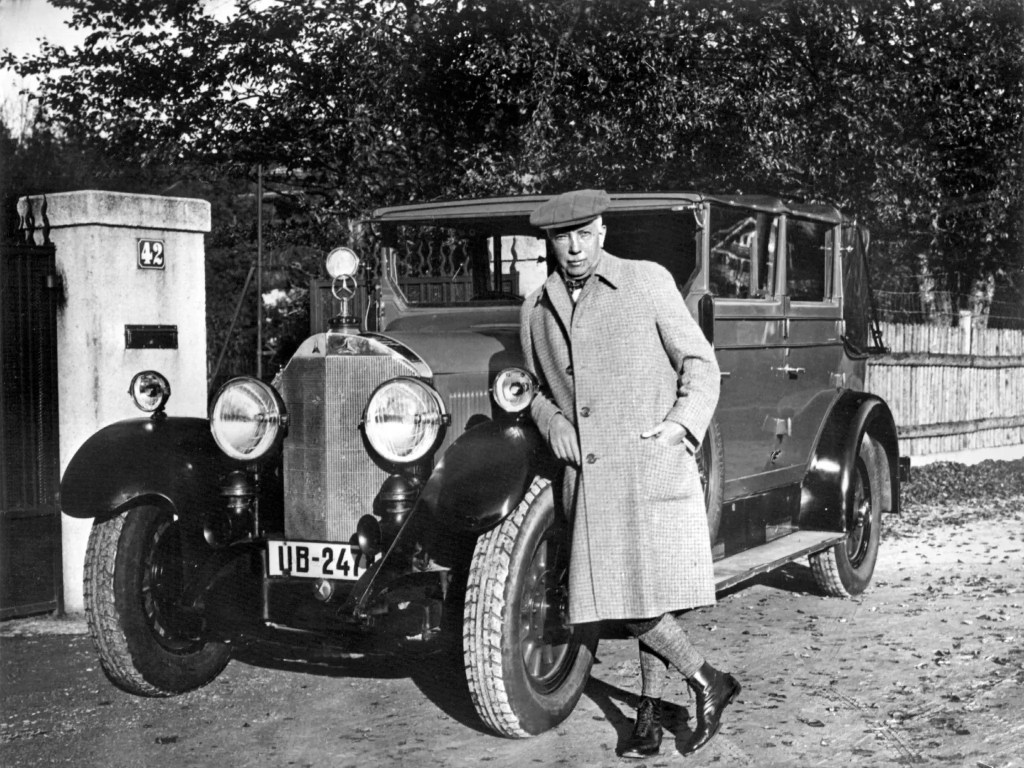
Richard Strauss was born in June 1864. I was born in June 1964. In a blog series about recordings made 100 years ago, that chronological nicety gives me a little thrill, as, with a stretch of imagination, I can put myself in Strauss’s polished shoes in 1922. (Though, unfortunately, I don’t have the Mercedes. And the photo’s from 1924, but never mind.)
Readers will have to forgive a bit of self-indulgence in this post as I’m going to write about my own relationship to Strauss’s music. As the last post in this series it’s good to take stock: the idea was to listen back to the music and culture of a single year – 1922. I’ve been amazed at the variety and quality of the recordings, and it has given me a clearer insight into the way recordings are not like photographs: yes, they capture a specific moment, but they also often contain an imprint of style and tradition from an even earlier time. The project has also given me a new appreciation of historical time. My theory is that as we get older, we can paradoxically feel closer to eras further back. I now have personal memories of 1972 – 50 years ago, so a further 50 years back doesn’t seem so far away.
I would describe my critical stance to the music of Strauss as ambivalent. For me there’s often an inexplicable hollowness at the centre that no amount of pre-Hollywood lushness or extraordinary technical mastery can fill. But just occasionally, I have to give in. As here, in this early song, Morgen! (“Tomorrow”, 1894) where time stands still: “And tomorrow the sun will shine again…”
In this hybrid version (neither voice and piano, nor orchestral), the solo violin (uncredited here) sustains the melody beautifully with generous portamenti, while – as often in Strauss’s hero Wagner – the voice is almost incidental. But what a voice: the young Richard Tauber, who, in 1922, signed a five-year contract with the Vienna State Opera where Strauss was Musical Director.
In his symphonic poem Don Juan (1888) the 24-year-old composer was even closer to the Wagnerian aesthetic, this time revelling in the ecstatic soundworld of the Bacchanale from Tannhäuser or the Act 3 Prelude from Lohengrin. Certainly, those repeated wind triplets accompanying the main violin melody, bracket together Don Juan with the Lohengrin Prelude for clarinettists who wish they had as fast a tonguing technique as their woodwind colleagues.
The 1921/22 season marked Strauss’s rehabilitation in the USA and Britain following years of anti-German sentiment. After a successful American tour, Strauss stopped in England on his way home for concerts and recording sessions with the London Symphony Orchestra. (There’s an interesting interview with the composer in the Guardian archives, published four days before the present recording.)
One of the remarkable things about this record is that it was made at all, bearing in mind the recording conditions of the time. The reduced orchestra, with no more than 20 strings (only 6 first violins!) crowds claustrophobically around the recording horn, as this ghostly low-fi photo of the session shows:
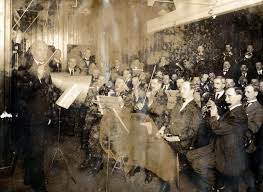
The low-frequency sounds of the double bass were notoriously difficult to reproduce in early acoustic recording, so here – as in most early jazz recordings – a tuba is added to strengthen the bass line. There must have some very competent and agile tuba players around at the time, who would have been able to name a decent fee for their services.
Despite – or perhaps because – of these limitations, the recording has an air of irrepressible energy – even desperation – about it. And the feeling of being trapped in a small room with no escape route is not necessarily an inappropriate reaction to being in the presence of Strauss’s eponymous seducer.
From seducer to seductress, we now turn to Strauss’s sensationalist opera of 1905, Salome – the work that held a distorted mirror up to bourgeois decadence and – along with its successor, Elektra (1909) – pushed the dissonant boundaries of musical expressionism to the very edge, and from which Strauss seems to have spent the rest of his composing career recoiling. Although, it must be said that the Dance of the Seven Veils is the least controversial part of the opera, musically speaking: more Sherezadian exoticism than Munchian existential angst, even though it was the scene that got the censors hyperventilating in the early days.
I associate this opera with my own personal angst as, in my early years playing with Welsh National Opera, I got one of those pulse-racing phone calls telling me that the first clarinet was ill and could I “sit up” and play principal clarinet in the opening night of Salome? It was just before the dress rehearsal so I got one run-through and then it was curtain up. The part is quite knotty, to say the least – the opera starts with a slithery scale on the clarinet, containing the harmonic seeds for the rest of the piece, and from there on there’s nowhere to relax. I have no memory of how well I played, only that I survived and – unlike John the Baptist – kept my head.
Listening to this recording straight after the London Don Juan, it is striking how much more balanced and blended the Philadelphia orchestral sound is. This is no doubt partly due to Stokowski’s intense interest in recording techniques and orchestral layouts (he is credited with establishing the now usual seating of violins 1 and 2, violas, and cellos, going left to right). There is a direct line from this recorded sound to the innovations in high fidelity and early stereo in later decades, and also – musically – to the neo-Straussian film scores of Korngold and his successors, as well as to the remarkable cartoon soundtracks by Carl Stalling and others. This, of course, came full circle in 1940 with Stokowski’s key role in Disney’s Fantasia.
Der Rosenkavalier was only 11 years old when the following recording of the waltz sequence was made in London – the day after the Don Juan above. The opera marks Strauss’s step away from the edge of the abyss of musical psychosis towards the more comforting distractions of 18th-century farce. Just as Wagner had written his 5-hour Der Meistersinger as a little light relief from the woes of mythological archetypes, so Strauss wrote his 4-hour sit-com that ends as a rom-com, showing that he could do comedy too (which of course he had already demonstrated orchestrally in Till Eulenspiegel and Don Quixote).
The addition of the tuba on the bass line this time brings the music perilously close to the sound of a Bavarian oom-pah band, and I wonder whether Strauss had a twinkle in his eye when he first heard it. After all, it’s not totally inappropriate for the Act 3 setting of “the back room of a dingy inn” (as the Met synopsis puts it), given that 19th-century waltzes are also totally anachronistic for a plot set in the 1740s.
Underlying the comic plot-line of a lecherous oaf being given his come-uppance, the opera has a more wistful message, dealing with the inevitability of the passing of time in the lives of the characters. The most effective production I have seen was in Helsinki some years ago, where, with the help of a revolving stage, the whole set gradually changed throughout the opera, but so slowly as to be imperceptible – quite literally a moving interpretation of the flow of time.
I’ve played in quite a few performances of Der Rosenkavalier and – like all Strauss – it is immensely satisfying to play: difficult, but so well written for each instrument that it’s worth the effort. Just like the couple of Alpine Symphonies I’ve played in, you struggle to get up the mountain, but the view from the top is glorious. My first ever work with Welsh National Opera was Der Rosenkavalier in 1994, playing in the off-stage waltz band. The music occurs in Act 3 – quite late in the opera, and I have the memory of hearing the start of the performance on the car radio on my journey from London to Cardiff as it was being broadcast live; quite a disconcerting experience, providing the material for quite a few performance-anxiety dreams in the years to come.
1922 is pretty close to the midpoint of Strauss’ composing career. It’s interesting just how many trajectories there are in the output of different composers: the short-lived firework (Mozart, Schubert), the creator who simply retires when all is said (Sibelius), the late developer (Janaček), the constant developer (Beethoven, Verdi). In my view, apart from a very few exceptions, Strauss had scored all his best goals in the first half. And I’m not even going to get into the controversies surrounding his later accommodation with the Nazi regime. Maybe, the last word should be left to the Marschallin, courtesy of librettist Hugo von Hoffmansthal, in Act 1 of Der Rosenkavalier:
Time is a strange thing. While one is living one’s life away, it is absolutely nothing. Then, suddenly, one is aware of nothing else. It is all around us – inside us, even! It shifts in our faces, swirls in the mirror, flows in my temples. It courses between you and me – silent, as in an hourglass. Oh, often I hear it flowing, irrevocably. Often I get up in the middle of the night and make all, all the clocks stand still.
[Richard Strauss: Morgen. Richard Tauber, tenor. Violin, piano: anonymous. Recorded Berlin, 1922.]
[Richard Strauss: Don Juan. London Symphony Orchestra, conducted by the composer. Recorded Clerkenwell Road Studio, London, 18 January 1922.]
[Richard Strauss: Salome’s Dance. Philadelphia Symphony Orchestra, Leopold Stokowski. Recorded Camden, New York, 5 December 1921.]
[Richard Strauss: Der Rosenkavalier, Waltz Sequence. London Symphony Orchestra, conducted by the composer. Recorded Clerkenwell Road Studio, London, 19 January 1922.]
 Listening Back
Leave a comment