
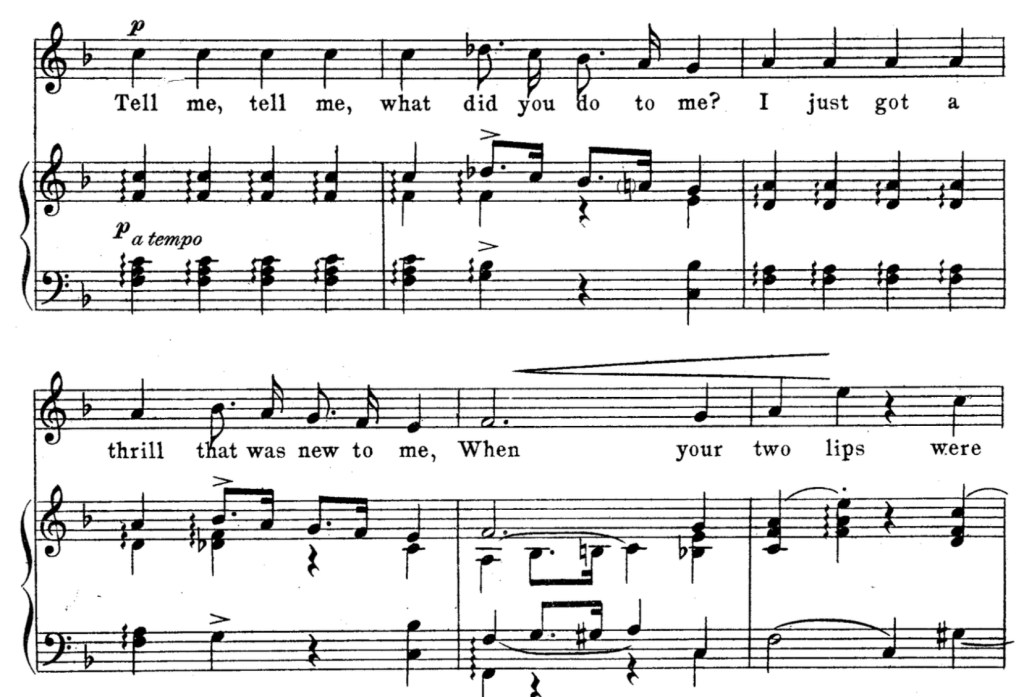
The 23-year-old George Gershwin was already a prolific composer by the time The French Doll opened on Broadway in February 1922. The musical comedy ran for 120 performances, but its lasting legacy was the single song that Gershwin wrote for the show: Do it Again, with racy lyrics by Buddy de Silva.

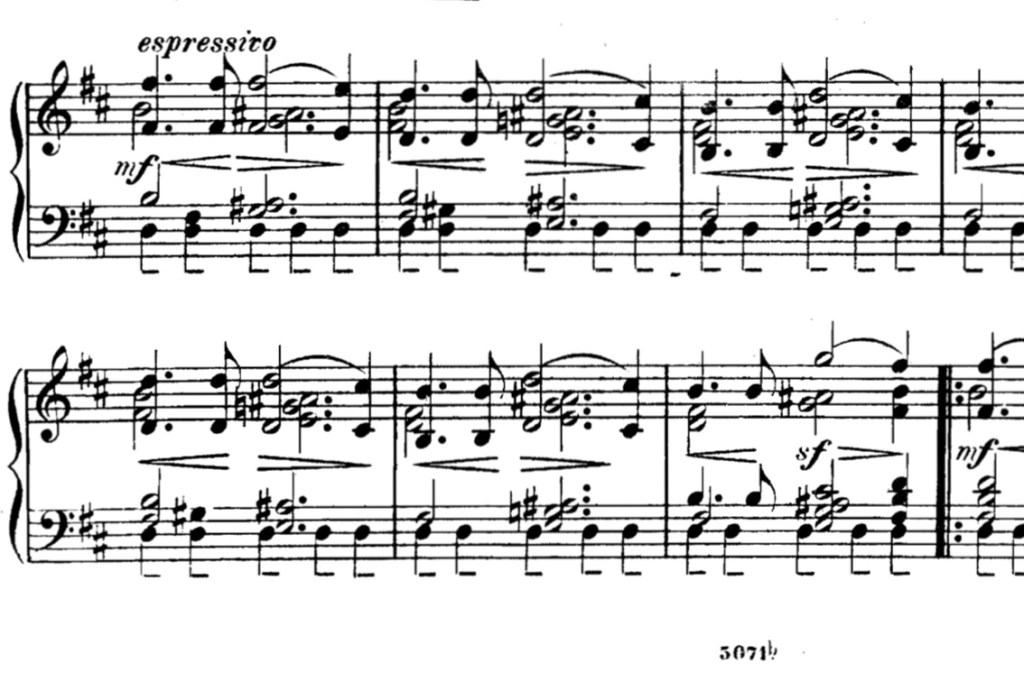
The song already has the touches of Gershwin’s later classics with its repetition of deceptively simple melodic phrases, and an underpinning of subtle harmonic touches that, if slowed down, could be by Tchaikovsky or Sibelius:
The speed of production in the New York music arranging, publishing, and recording industries matched the assembly line of the Ford Motor Company in the 1920s, and in the space of of a few weeks and months the tune had been released on record by multiple dance bands.
Here are four of those hot-off-the-press versions, each followed a by a few comments on some of their noteworthy features:
Joseph Samuels was a busy bandleader and multi-instrumentalist about whom not much is known. My guess is that he is the soloist playing the melody at 0:29. I’m still not absolutely convinced that this is a clarinet, rather than a Sidney Bechet-like soprano saxophone. But there is one little touch that shows the player’s Jewish background, whoever he was – an unmistakable klezmer lick at 0:33.
This is the only one of the four recordings featuring a vocalist – the vaudeville artist Arthur Hall at 1:31. A man singing the lyrics originally written for a woman emphasises that the song’s saucy subject is really a projection of what a man would like to hear a woman say!
Ernest Hussar’s orchestra was the resident dance band at Hotel Claridge, New York. This version starts with a similar score to the previous version, but then goes a little off course, with a nice little modulating excursion at 2:15, and a classy coda from 3:05, but nothing to shock the well-dressed hotel guests.
Paul Whiteman’s version is unsurprisingly suave and sophisticated, and performed with precision and discipline. As with all these fox-trot arrangements, the rhythm is taut and over-dotted – the almost military spring-loading in the staccato articulations of trumpets and banjo has not yet given way to the more relaxed swing rhythms of jazz.
This is the only version to experiment with extended sections in minor keys (at 1:09): F minor, then G minor, followed by a chorus in G major, before returning home to F major. Then, just before the end, there is a cheeky diversion to a distant A major (2:59) – a forgivable bit of showing off from a clever arranger.
I’ve saved my favourite one to last. We’ve come across Harry Raderman before – as a trombonist in some classic klezmer. Here, he is leading his dance band from the stand of his laughing slide trombone in an up-tempo version of the Gershwin tune. This arrangement’s got a bit of everything: even a duet for glockenspiel and kazoo – not something you hear every day (1:20).
And it’s just as clever as the Whiteman (which was recorded 6 days earlier): extended modulations to B flat major and G major, followed by some nice classical quotation at 3:11, whose source I can’t put my finger on (answers in the comment box below please).
For the final course (at 3:20) we’re treated to a serving of dixieland improvisation, giving this version a spirit of spontaneous joy that doesn’t always come across in a recording studio.
I defy anyone to listen to this record without a smile on their face!
[George Gershwin: Do it Again. Joseph Samuels’ Music Masters. Vocal Chorus by Arthur Hall. Recorded 1922]
[George Gershwin: Do it Again. Ernest Hussar and his Orchestra Hotel Claridge, N.Y. City. Recorded 1922]
[George Gershwin: Do it Again. Paul Whiteman Orchestra. Recorded New York, 28 March 1922]
[George Gershwin: Do it Again. Harry Raderman´s Orchestra. Recorded New York, 3 April 1922]
 Listening Back
Leave a comment