This is a woman with attitude. This is a band with attitude. Mamie Smith and her Jazz Hounds were launched into the world of recorded music as the real sound of African American jazz in the early 20s after several years of an often fairly tidied up version in more respectable arrangements by mostly white musicians. The release of Crazy Blues in 1920 is widely regarded as the first blues song recorded by an African American artist.
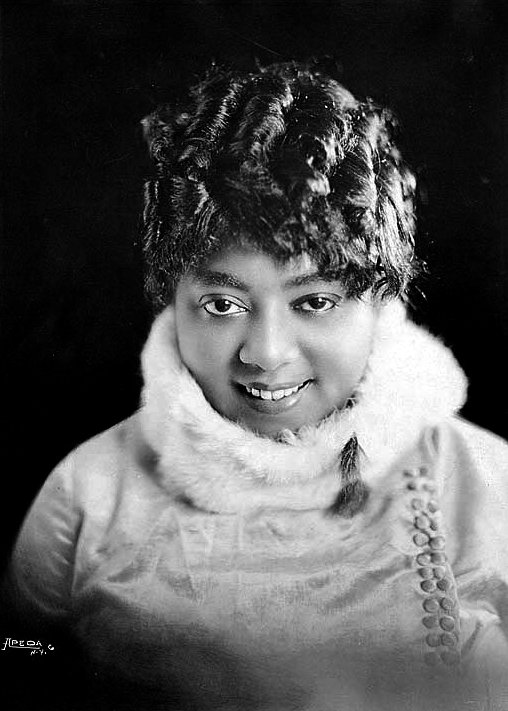
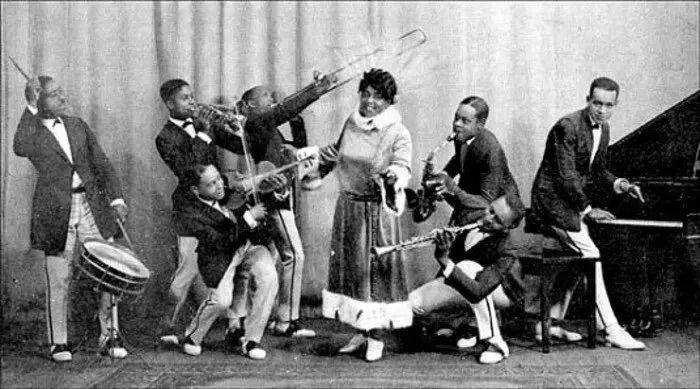
This 1922 recording of Don’t Mess With Me is raw organised chaos. There’s no obvious band leader apart from Mamie Smith herself, riding the waves of sound like the figurehead of a ship on stormy waters. At the age of 41 she must have been twice the age of most of her band members and there’s definitely no messing with her musical authority.
The sound of this band of improvising musicians is remarkable: wild and dangerous, with its instability emphasised by the lack of a real bass instrument, though the trombone and baritone sax vie with each other to interject fragments of low growls and barks – the baritone possibly played here by a 17-year-old Coleman Hawkins who had just joined the band. (Smith had tried to recruit him a year earlier, but his family said he was too young.)
We’re listening to jazz history in the making. Hawkins went on to become one of the great tenor saxophone soloists, and the trumpeter James ”Bubber” Miley (just 19 years old here) was soon to provide an important ingredient as part of the Duke Ellington sound.
And what’s that high wailing noise flying around all over the place? Presumably it’s the violinist doing his wild and crazy thing, duelling while balancing on a high wire with his clarinettist colleague.
Now, when the trumpets sounded, even the saxophones, then the multitude arose, two by two and stood upon the floor and shook with many shakings.
from Zora Neale Hurston: The Book of Harlem (1927)
Mamie Smith’s recordings are an essential part of what became know as the Harlem Renaissance: that cultural flowering of African American art and literary life in the 1920s, celebrating and questioning the role of black culture in society and politics. Not only did the mass migration of African Americans from the south to the north, and specifically to Harlem in New York, lead to a flourishing of art, but it also provided a mass audience for “ethnic” jazz records, something that OKeh Records recognised when they took on Mamie Smith and her Jazz Hounds.
Smith’s singing in Don’t Mess With Me is a rebuke to the prevalent sexism of the time, portrayed so well in the short stories of Zora Neale Hurston:
… Jim flopped into a chair and held forth at great length on the necessity of keeping wives in their places; to wit: speechless and expressionless in the presence of their lords and masters and cited several instances where men had met their downfall and utter ruin by ill advisedly permitting their wives to air their ignorance by talking. His audience, composed entirely of males, agreed with him.
from Zora Neale Hurston: The Conversion of Sam (1922)
Part of the strength of this song is that, though the subject matter is often quite violent, the text (credited, like the music, to Sam Gold) is sublimely witty, with some great rhyming couplets:
If I land on you (oh Lord),
Next time people talk to you, it’ll be through a Ouija board
[Note: spiritualism and contacting the dead via Ouija boards were at their heyday in the 1920s.]
And of course it’s not just the words and music, but how they are delivered that counts. And no one could deliver this gritty song of revenge, mockery, and female power better than the stupendous Mamie Smith, with her Jazz Hounds yapping at her heels.
The gifts divine are theirs, music and laughter:
from Claude MacKay: Harlem Shadows (1922)
All other things, however great, come after.
[Mamie Smith and her Jazz Hounds: Don’t Mess With Me (Sam Gold – composer and lyricist). Recorded New York, December 1922]
 Listening Back
Leave a comment