This is the music of borders. Or the crossing of borders.
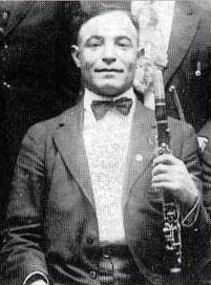
The great klezmer clarinettist, Naftule Brandwein crossed the maritime border of the USA in April 1909 to join his brother Israel who was already living in New York. But his musical journey had begun much earlier – from birth in fact, as he was born into a musical dynasty of klezmorim in 1884. In the Jewish communities of Eastern Europe, music was a hereditary profession.
Following the ineluctable law of the East, every poor man, including therefore the musician, has numerous children. In the musician’s case this is both good and bad, for the sons will go on to be musicians in turn, and form a “band”, which, the bigger it is, the more money it will earn. The more people who bear the family name, the more the band’s renown will grow. Sometimes a later descendant of this family will go out into the world, and become a celebrated virtuoso. There are a few such now living in the West; it would serve no purpose to name them. Not because it might somehow embarrass them, but because it would be unfair to have their greatness confirmed by any talented descendants.
Joseph Roth, trans. Michael Hofmann, The Wandering Jews (1926)
What a gift for words Joseph Roth had! And what a delight to discover that one of my literary heroes and my favourite klezmer musician were born 10 years apart and only about 50 miles from each other, near Lemburg (now Lviv) in Austro-Hungarian Galicia (now part of Ukraine), though thoughts soon turn to the subsequent catastrophic history of Jews in this part of Europe as well as to the current daily news of war in the region.

Galicia (not to be confused with the similarly named region of northern Spain) is one of those resonant names – like Bessarabia and Bukovina – that summon up a lost world of East European Jewry, as well as a centuries-long era of constantly shifting borders, when inhabitants found themselves suddenly citizens of another state or empire – or were forced to move to a new place.

Joseph Roth spent most of his adult life living out of a suitcase. Though he is best known for his masterly end-of-empire novel, The Radetzky March (note how the title uses a musical association to conjure up a lost age), the books that sit constantly on my bedside table are the collections of short articles that he wrote regularly for various European newspapers. These feuilletons – as they were known – were written in cafés and hotels around Europe, and they have an almost musical improvisatory quality as spontaneous observations of everyday life in the 1920s and 30s. As Roth wrote, “Only the small things in life are important”. Here is a sample from a sketch written in Berlin in 1922:
Sometimes a ride on the S-Bahn is more instructive than a voyage to distant lands. Experienced travelers will confirm that it is sufficient to see a single lilac shrub in a dusty city courtyard to understand the deep sadness of all the hidden lilac trees anywhere in the world…
A boy listens to a big phonograph on the table before him, its great funnel shimmering. I catch a brassy scrap of tune and take it with me on my journey. Torn away from the body of the melody, it plays on in my ear, a meaningless fragment of a fragment, absurdly, peremptorily identified in my memory with the sight of the boy listening.
Berliner Börsen-Courier, April 23, 1922 (trans. Michael Hofmann)
Just a few months after Roth wrote these lines, Naftule Brandwein was making his first recording as a solo clarinettist in the Columbia studio in New York, starting his Doina with an improvised “fragment of a fragment”.
The doina is – like many klezmer forms – an adaptation (perhaps a “yiddishification”) of a musical form and style of a particular regional folk tradition. It is a semi-improvised solo over sustained chords, usually – as here – followed by one or two faster dances. It has much in common with the Turkish taksim, the slow lassú section of the Hungarian verbunkos, and its function as a slow introduction even recalls the recitative section preceding a classical aria. There is also a clear connection to the style of Jewish cantor recitation.
The specific regional form that klezmer musicians borrowed (no accusations of “cultural appropriation” please) is the Romanian doina. Here’s a good example:
For Brandwein’s doina, he has metaphorically crossed the Carpathian mountain range – the natural border between Galicia and Romania. He has also crossed the boundary between urban and rural. The Romanian doina is the music of shepherds – there is often an unwritten “story” in the music of a lament for a lost sheep, followed (in the fast section) by a celebration of its return. As it is unlikely that there were very many Jewish shepherds in Eastern Europe (agriculture was usually out-of-bounds to Jews), this is another example of the crossing of imaginary borders.
That was how things were back then. Anything that grew took its time growing, and anything that perished took a long time to be forgotten. But everything that had once existed left its traces, and people lived on memories just as they now live on the ability to forget quickly and emphatically.
Joseph Roth, The Radetsky March (1932)
[Rumeinishe doina, Naftule Branwein (clarinet) and orchestra. Recorded approx. September 1922, New York]
 Listening Back
Leave a comment