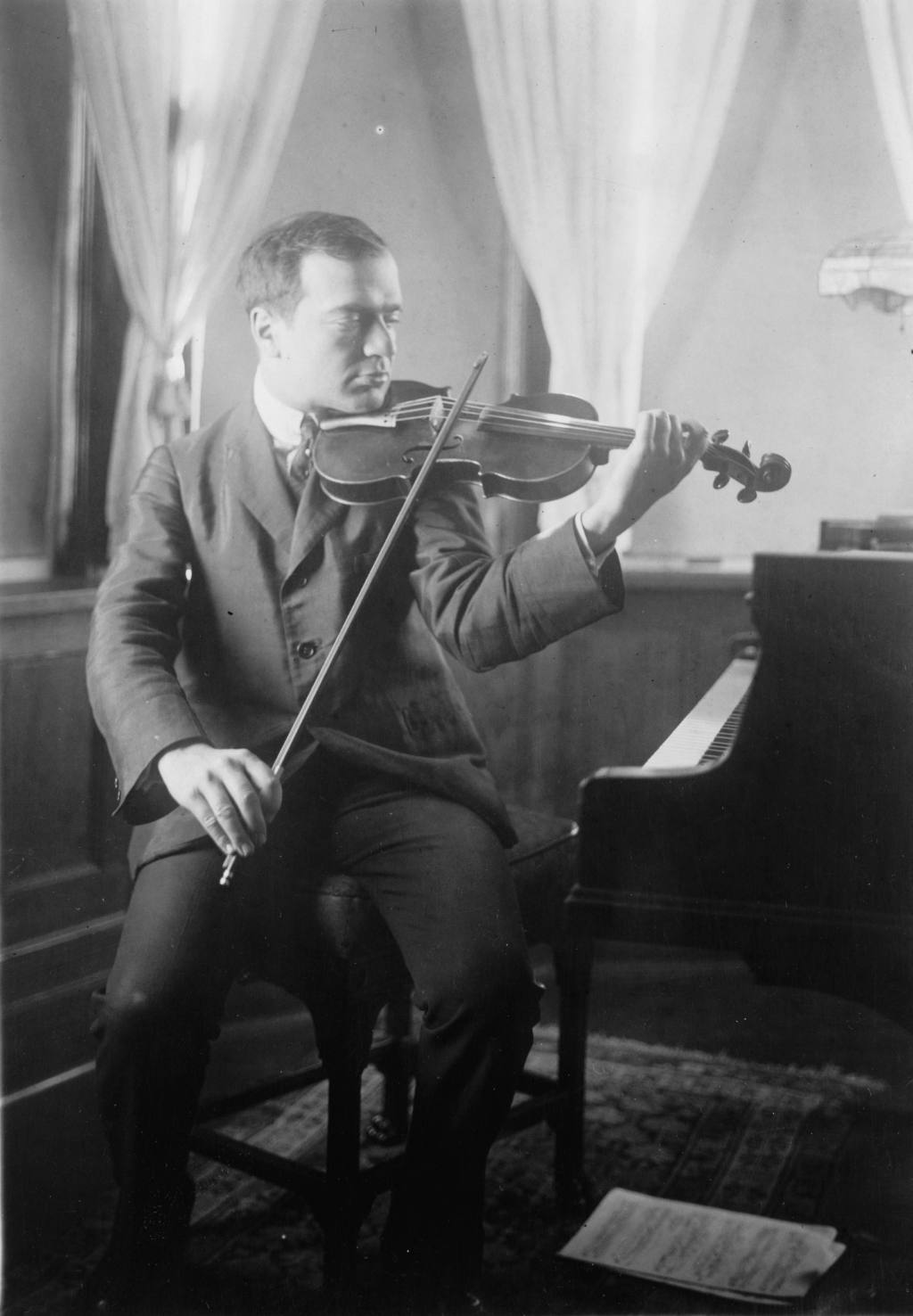
If you’re a world-class musician at the height of your fame, and your country, or the country where you perform, commits crimes against humanity, what do you do or say?
If you want to take an ethical stance, there are essentially two alternatives: the Furtwängler option and the Huberman option.
As the Nazi Party tightened its grip on Germany in the 1930s, the conductor of the Berlin Philharmonic, Wilhelm Furtwängler, decided to stay in Germany, hoping that his musical art could somehow rise above the evil around him. The risk was that he and his orchestra would be used as a propaganda weapon to give Nazism a positive spin.
The Polish-Jewish violinist Bronisław Huberman, on the other hand, refused to play in Nazi Germany. As he wrote to a friend in 1933,
“I am a Pole, a Jew, a free artist and a pan-European. In each of these four character traits, I must see Hitlerism as my mortal enemy, I have to fight it with all the means at my disposal as my honour, my conscience, my reflection and my impulse dictate”,

The danger signs in Europe were clearly evident a decade earlier. In July 1921 Hitler became chairman of the National Socialist Party, which had previously announced that only those of “pure Aryan descent” could become members. And in October 1922 German fascists took heart from Mussolini’s March on Rome and subsequent coup d’état in Italy.
By the early 20s, Huberman was already politically active. During several tours of the USA – including the one during which this Brahms recording was made – he took inspiration from the federal structure of the host country, to develop ideas for a multi-nation Pan-Europe.
But although it’s tempting to always look forward by considering the early 1920s as the start of the modern age, it’s also good to take an occasional glance in the rear-view mirror.
Johannes Brahms died only 25 years before the date of this recording – the equivalent of a composer dying in 1997 from our viewpoint in 2022. As a young prodigy, Huberman played the Brahms concerto in the presence of the composer in Vienna (the audience also included Johann Strauss, Anton Bruckner, and Gustav Mahler!). So this performance is a link to the aesthetics and musical style of an earlier age.
This is pre-Machine Age rhythm. A human pulse, not a mass-produced beat – responding to the fluctuations of blood circulation and nerve responses of the body that occur both during dance (physical movement) and during changes of emotional state. This is music-making that exults in the joy of being free. As Huberman himself wrote,
The true artist does not create art as an end in itself; he creates art for human beings. Humanity is the goal.
[Brahms, arr Joachim: Hungarian Dance No. 1. Bronisław Huberman – violin, Paul Frenkel – piano. Recorded New York, approx. January 1922]
 Listening Back
Leave a comment