Two sisters from Vienna. Erika, about 17 years old, sits casually – her right leg underneath her, holding a copy of the Musical Courier. She wears a sailor-suit ribbon to emphasise her youth. Her smile still has a hint of adolescent self-consciousness about it. Alice, 8 years older, sits on the arm of the sofa and stares at the camera with a more knowing look. A publicity shot for their first American tour, though neither sister is new to being in the public eye. After all, Erika had played at a birthday party for Austrian Emperor Franz Joseph at the age of 5 and had already played concertos with Fürtwängler in Berlin and Nikisch in Leipzig while in her early teens.

This photo was probably taken shortly after Morini’s Carnegie Hall debut on January 16, 1921 in New York. The concert was a sensation and was followed by a 60-date tour of North and South America over the next few months. Soon snapped up by the Victor Talking Machine Company, in March and April 1921 the two sisters were taken to the studio in Camden, New Jersey where they recorded a few short pieces, including Wieniawski’s Cappriccio-Valse. They played it 7 times. Take number 5 was selected (the other 6 were destroyed) and it was released on several labels in 1921 and 1922.
It’s a typical violin showpiece, but played with such wit and sophistication that it doesn’t sound like showing off. It’s like watching a masterful trapeze artist: the thrill of seeing almost-impossible patterns drawn in the air, alongside a slight buzz of danger, balanced by the conviction that the artist is in complete control. The recording is pre-electrical: microphones didn’t come in until 1925. The large horn used to capture sound had a limited dynamic and frequency range, so how is it possible that we can still appreciate Morini’s superlative violin tone? Does our brain compensate for the lack of high fidelity, in a similar way that we don’t necessarily miss the lack of colour in black and white photographs?
The copy of the Musical Courier (“Weekly Review of the World’s Music”) in Erika’s hands could be the one containing the advertorial from her tour management reproduced below. A search of the magazine’s archive online in the period of the American tour reveals a strikingly modern approach to PR and its attendant hype. There’s the fake news of reports from the Viennese press that Morini was getting paid $6,000 per concert; the cringeworthy interview asking about boyfriends.
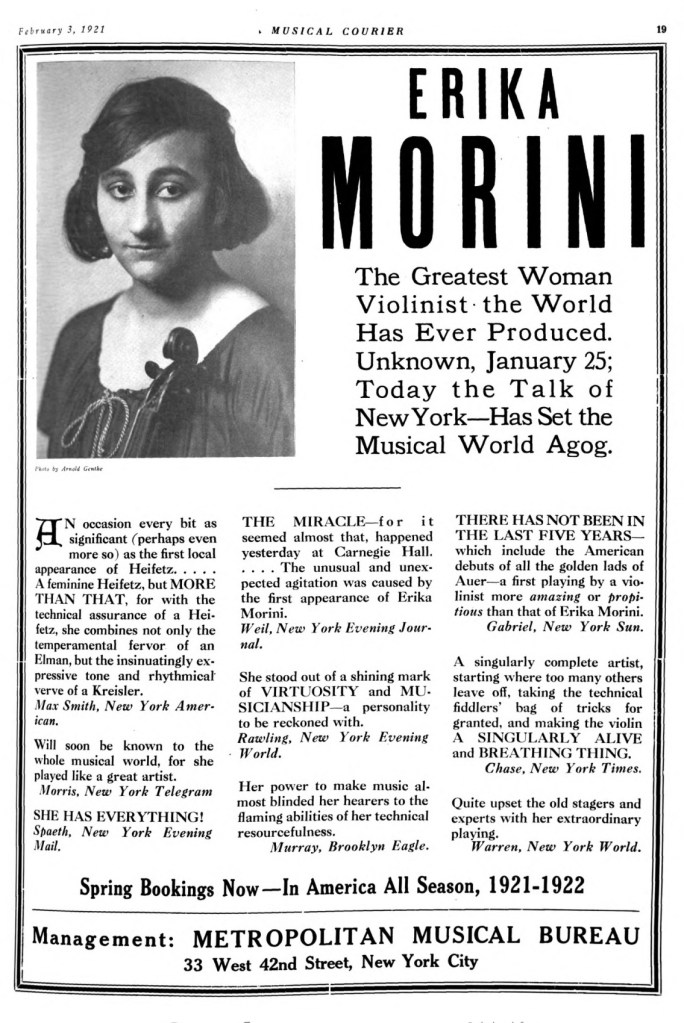
And what about the next 50 years of Erika Morini’s career? (She gave her last concert in 1976 and died in 1995, having, in 1938 – as a prominent Jewish musician – made the inevitable move to the USA.) She certainly continued to play at the highest level, and there are some wonderful recorded performances, including a riveting Tchaikovsky concerto from 1940 with Stravinsky conducting the New York Philharmonic. But she never received the attention of her male peers. Even today, Heifetz has about 340 times as many monthly listeners on Spotify, and Kreisler about 1300 times.
So it somehow seems even more poignant to listen to these glittering four and a half minutes of recorded time from one hundred years ago and imagine what might have been.
[H. Wieniawski: Capriccio Valse, Op. 7. Erika Morini – violin, Alice Morini – piano. Recorded Camden, New Jersey April 6, 1921. Released 1922.]
 Listening Back
Leave a comment